
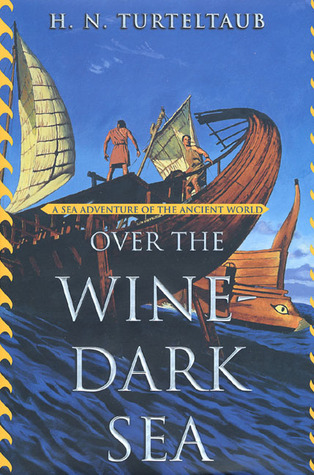
Over the Wine-Dark Sea
Описание
In ancient Rhodes, young sea captain Menedemos and his scholarly cousin Sostratos embark on a grand trading expedition, traversing the Mediterranean from Asia Minor to Italy. Their journey is filled with the exchange of wine, silks, and surprisingly, peacocks. They encounter the unfamiliar and sometimes hostile cultures of the region, including the nascent Roman civilization. The narrative is rich with historical detail and vivid descriptions of the era, offering a captivating glimpse into the lives of merchants and travelers in the ancient world. The book's focus on trade, cultural exchange, and the clash of civilizations provides a unique perspective on history and human interaction.
This book is for Professor Stanley Burstein of California State University, Los Angeles, and for Noreen Doyle, with many thanks for their friendship and for their help with my research.
I have, as best I could, used in this novel the weights, measures, and coinages my characters would have used and encountered in their journey. Here are some approximate equivalents (precise values would have varied from city to city, further complicating things):
1 digit = 3/4 inch
4 digits = 1 palm
6 palms = 1 cubit
1 cubit = 1 1/2 feet
1 plethron = 100 feet
1 stadion = 600 feet
12 khalkoi = 1 obolos
6 oboloi = 1 drakhma
100 drakhmai = 1 mina
(about 1 pound of silver)
60 minai = 1 talent
As noted, these are all approximate. As a measure of how widely they could vary, the talent in Athens was about 57 pounds, while that of Aigina, less than thirty miles away, was about 83 pounds.
Menedemos and his cousin Sostratos walked down toward the Aphrodite in the main harbor of Rhodes. Both young men wore thigh-length wool chitons. Sostratos had a wool chlamys on over his tunic. He didn't really need the cloak, though; it was still late in the month of Anthesterion, before the vernal equinox, but the sun shone warm out of a clear blue sky. Like any men who often went to sea, the two cousins went barefoot even on dry land.
A mild breeze blew down from the north. Tasting it, Menedemos dipped his head in anticipation. "Good sailing weather coming soon," he said. He was little and lithe and very handsome, his face clean-shaven in the style Alexander the Great had made popular twenty years before.
"Sure enough," Sostratos agreed. He'd spent enough years studying in Athens to have a sharper accent than the Doric drawl usual in Rhodes. Careless of fashion, he'd let his beard grow out. He towered more than half a head above his cousin. "Some traders have already put to sea, I hear."
"I've heard the same, but Father says it's too early," Menedemos answered.
"He's probably right." Sostratos, as far as Menedemos was concerned, showed altogether too much self-restraint for someone only a few months older than he was.
"I want to be out there," Menedemos said. "I want to be doing things. Whenever we sit idle over the winter, I feel like a hare caught in a net."
"Plenty to do during the winter," Sostratos said. "It's what you do then that lets you succeed when you can sail."
"Yes, Grandfather," Menedemos said. "No wonder I command the Aphrodite and you keep track of what goes aboard her."
Sostratos shrugged. "The gods give one man one thing, another man another. You're always ready to seize the moment. You always have been, as long as I can remember. As for me . . ." He shrugged again. Even though slightly the older and much the larger of the two of them, he'd had to get used to living in Menedemos' shadow. "As you said, I keep track of things. I'm good at it."
"Well, nobody can quarrel with you there," Menedemos said generously. He raised his voice to a shout and hailed the akatos ahead: "Ahoy, the Aphrodite!"
Carpenters in chitons and naked sailors aboard the merchant galley waved to Menedemos and Sostratos. "When do we go out, skipper?" one of the sailors called. "We've been stuck in port so long, my hands have got soft."
"We'll fix that, don't you worry," Menedemos said with a laugh. "It won't be long now, I promise." His sharp, dark-eyed gaze swung to a carpenter at the poop of the forty-cubit vessel. "Hail, Khremes. How are those new steering oars coming?"
"They're just about ready, captain," the carpenter answered. "I think they'll be even smoother than the pair you had before. A little old bald man sitting in a chair with a cushion under his backside could swing your ship any way you wanted her to go." He waved in invitation. "Come on up and get the feel of 'em for yourself."
Menedemos tossed his head to show he declined. "Can't really do that till she's in the water, not hauled out to keep her timbers dry." Sostratos following him, he walked toward the bow of the ship. The Aphrodite had twenty oars on either side, giving her almost as many rowers as a pentekonter, but she was beamier than the fifty-oared galleys so beloved by pirates: unlike them, she had to carry cargo.
Sostratos tapped the lead sheathing the Aphrodite below the waterline with a fingernail. "Still good and sound."
"It had better be," Menedemos said. "We just replaced it year before last." He tapped, too, at one of the copper nails holding the lead and the tarred wool fabric below it to the oak planking of the hull.
Похожие книги

Гибель гигантов
Роман "Гибель гигантов" Кен Фоллетт погружает читателя в атмосферу начала XX века, накануне Первой мировой войны. Он описывает судьбы людей разных социальных слоев – от заводских рабочих до аристократов – в России, Германии, Англии и США. Их жизни переплетаются в сложный и драматичный узор, отражая эпохальные события, войны, лишения и радости. Автор мастерски передает атмосферу того времени, раскрывая характеры героев и их сложные взаимоотношения. Читайте захватывающий роман о судьбах людей на пороге великих перемен.

Лавр
Евгений Водолазкин, известный филолог и автор "Соловьева и Ларионова", в новом романе "Лавр" погружает читателя в средневековую Русь. Герой, средневековый врач с даром исцеления, сталкивается с неразрешимым конфликтом: как спасти душу человека, если не можешь уберечь его земной оболочки? Роман исследует темы жертвы, любви и веры в контексте средневековой России. Врачебное искусство, вера и человеческие отношения сплетаются в увлекательном повествовании, где каждый персонаж и каждое событие обретают глубокий смысл. Книга погружает в атмосферу средневековья, раскрывая внутренний мир героя и его непростую судьбу.
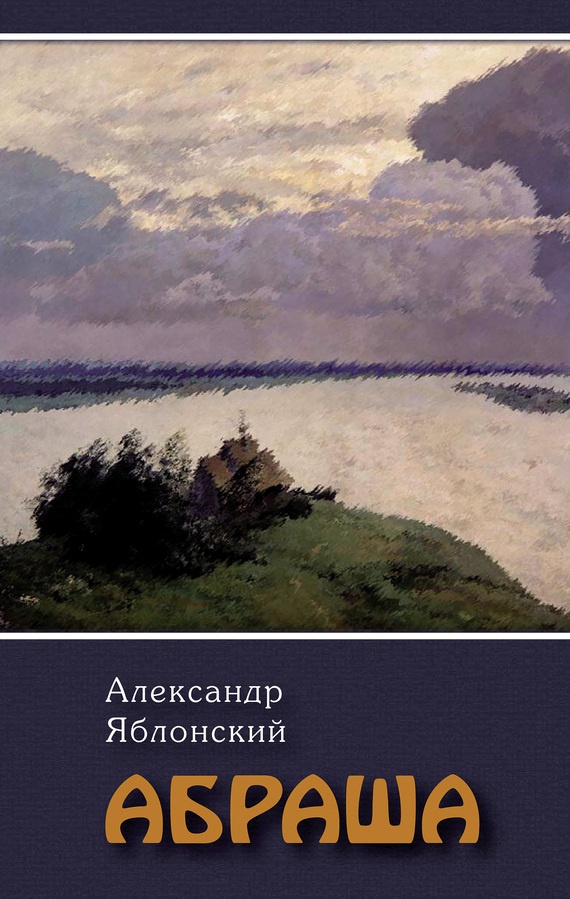
Абраша
В романе "Абраша" Александра Яблонского оживает русская история, сплетающая судьбы и эпохи. Этот исторический роман, наполненный душевными размышлениями, исследует человеческую волю как силу, противостоящую социальному злу. Яблонский мастерски передает атмосферу времени, используя полифоничный стиль и детективные элементы. Книга – о бесконечной красоте человеческой души в сложные времена.

Аламут (ЛП)
В романе "Аламут" Владимир Бартол исследует сложные мотивы и убеждения людей в эпоху тоталитаризма. Книга не является пропагандой ислама или оправданием насилия, а скорее анализирует, как харизматичные лидеры могут манипулировать идеологией, превращая индивидуальные убеждения в фанатизм. Автор показывает, как любая идеология, будь то религиозная, националистическая или иная, может быть использована в опасных целях. Роман основан на истории Хасана ибн Саббаха и его последователей, раскрывая сложную картину событий и персонажей. Книга предоставляет читателю возможность задуматься о природе идеологий и их влиянии на людей, а также о том, как важно сохранять нравственные принципы.